A Claude Code demo is easy to love.
You describe a feature, the agent edits files, runs commands, fixes its own mistakes, and suddenly the repository has moved. The first time you see it work, it feels like software engineering has skipped a generation.
But the demo is not the hard part.
The hard part is making that same capability safe enough, repeatable enough, and observable enough that you would trust it inside a real engineering workflow. That is where the actual product begins.
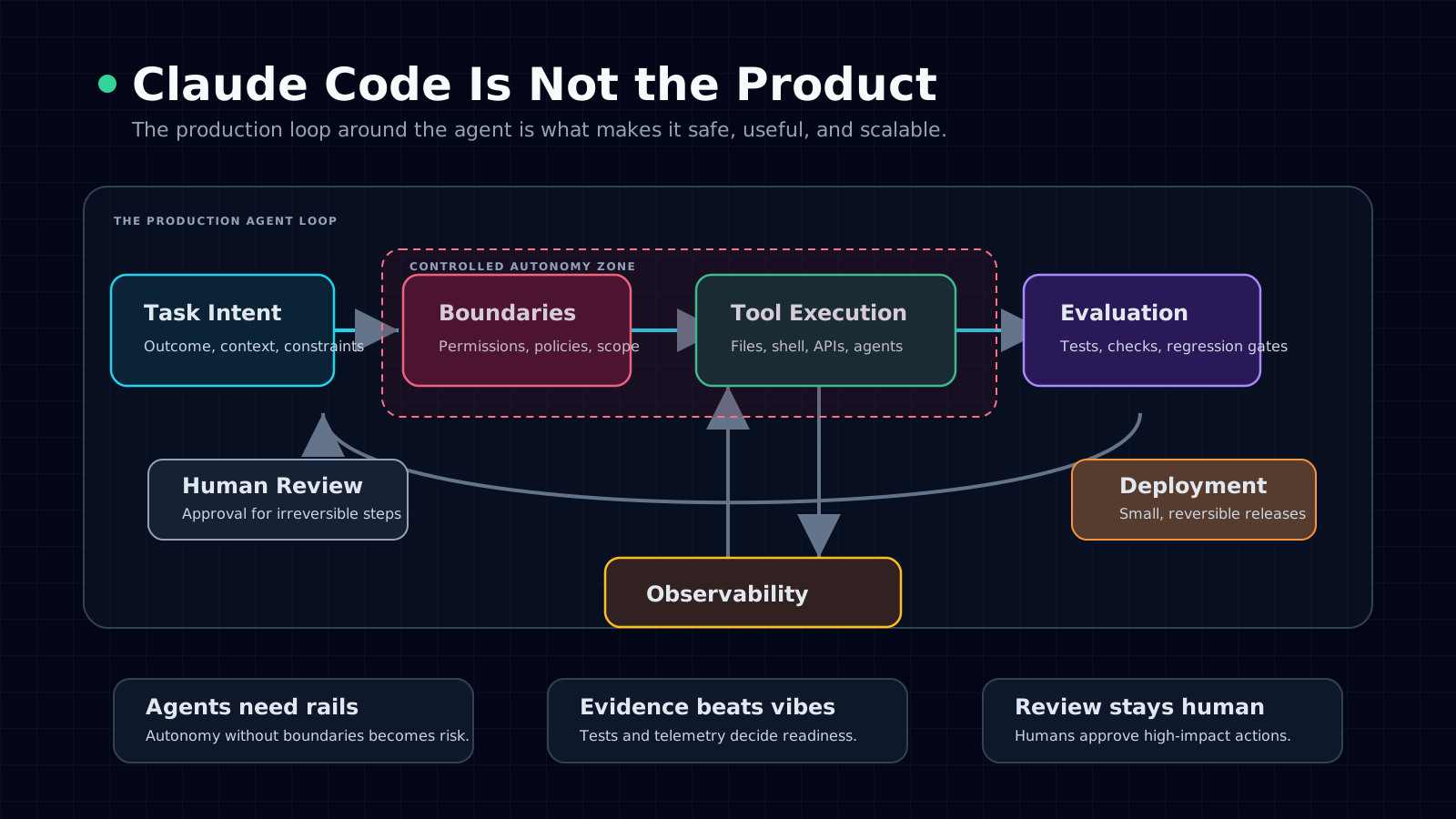
Claude Code is powerful, but Claude Code by itself is not a production system. The production system is the loop around it.

The dangerous version of agentic coding
The dangerous version is simple:
- Give the agent broad access.
- Ask for a large outcome.
- Let it modify the codebase.
- Hope the result is correct.
This can be fine for experiments, prototypes, and weekend projects. It is not how I would run serious production work.
When an AI coding agent can read files, write files, execute shell commands, call APIs, install dependencies, open pull requests, and potentially touch deployment paths, you no longer have “just a chatbot”. You have an automated actor inside your engineering system.
That actor needs boundaries.
The production loop
A production Claude Code workflow should look less like magic and more like a controlled operating loop:
Task intent
→ Boundaries
→ Tool execution
→ Evaluation
→ Observability
→ Human review
→ Deployment
→ Feedback into the next task
Each part matters.
1. Task intent
The agent needs a narrow, explicit task.
Not:
Improve the app.
Better:
Add server-side validation to the signup endpoint. Preserve the existing API response shape. Add tests for missing email, invalid email, and duplicate email. Do not change the database schema.
The more precise the task, the easier it becomes to evaluate the result.
2. Boundaries
Autonomy without boundaries is risk.
Good boundaries include:
- which files the agent may touch
- which commands it may run
- whether network access is allowed
- whether dependency changes are allowed
- whether migrations are allowed
- what must remain backwards compatible
- what requires human approval
This is not bureaucracy. This is how you convert an impressive demo into a repeatable engineering process.
3. Tool execution
The agent should be able to use tools, but tool access should not be treated as all-or-nothing.
Reading files is low risk. Editing a small module is medium risk. Running tests is usually desirable. Changing infrastructure, secrets, billing, production data, or deployment settings is a different category entirely.
A production agent system should understand that difference.
4. Evaluation
If there is no evaluation, there is no production readiness.
At minimum, the agent should be pushed through:
- unit tests
- integration tests
- linting or type checks
- security checks where relevant
- a review of the actual diff
- regression checks for the behaviour it touched
The best agent workflows are not the ones where the model sounds confident. They are the ones where the system can gather evidence that the change is safe.
5. Observability
If you cannot see what the agent did, you cannot improve the workflow.
Useful observability includes:
- prompts and task instructions
- files changed
- commands run
- tests executed
- failures encountered
- retries performed
- final diff
- human approval decisions
This matters because agentic coding is not just about generating code. It is about building a learning loop around the work.
6. Human review
The goal is not to remove humans from engineering.
The goal is to move humans to the highest-leverage points:
- defining intent
- setting constraints
- reviewing architectural decisions
- approving risky actions
- deciding whether the trade-off is acceptable
In a good workflow, the agent does the mechanical work and the human remains responsible for judgment.
7. Deployment
Deployment should be the most controlled part of the loop.
An agent can prepare a release, update a branch, open a pull request, write release notes, and summarize risk. But irreversible steps should be gated until the team has confidence in the process.
Small, reversible releases beat heroic automation.
Why this matters now
The debate around Claude Code, Codex, OpenCode, Cursor, and the next wave of agentic coding tools often focuses on model quality.
That matters, but it is not the whole story.
For real teams, the bigger question is:
Can we design a workflow where AI agents produce useful changes without quietly increasing operational risk?
That question is less about prompting and more about systems engineering.
The teams that win with AI coding agents will not simply be the teams with the most powerful model. They will be the teams with the best loops: clear intent, bounded autonomy, strong evaluation, useful telemetry, and disciplined review.
From vibe coding to production agents
I still believe in the power of “vibe coding”. It changes what one person can build. It compresses the distance between idea and prototype.
But production is different.
Production requires a shift from:
Can the agent build something impressive?
to:
Can the system make agent work safe, reviewable, and repeatable?
That is the transition I care about most.
It is also the reason I am writing Claude Code: Building Production Agents That Actually Scale.
The book is not about treating Claude Code as magic. It is about the engineering discipline around the magic: permissions, tool governance, context management, evaluation, observability, cost control, and human-in-the-loop workflows.
Because Claude Code is not the product.
The production loop is.
I am currently writing the book here: Claude Code: Building Production Agents That Actually Scale